Around this time each year, I update my analysis of representation in U.S. Country radio airplay. The timing often falls within or as we move from Black History Month into Women’s History Month, a period that invites reflection on whose voices are heard—and whose remain largely absent—in the industry.
Two years ago I participated in the annual meeting of Country Radio Seminar for the first time on a panel titled “Diversi’Tea: Spilling the Data on Inclusive Programming.” On that panel, I shared findings showing that songs by women had fallen to a historic low in 2023: just 9.87% of the total airplay on U.S. country radio. Nearly all of that airplay was for songs by white women, while songs by Black women and other women of colour were virtually absent from playlists. This panel took place just two weeks after Beyoncé dropped “Texas Hold ‘Em”, giving us a lot to talk about.
Last year I returned with updated numbers for 2024. Despite moments that appeared to signal progress—including the extraordinary success of Beyoncé’s “Texas Hold ’Em”—the overall picture continued to decline. Songs by women received just 8.39% of total airplay, and again almost all of it was for songs by white women.
Now, with the 2025 data, the situation remains essentially unchanged.
Actually, it’s worse.
Let’s take a closer look.
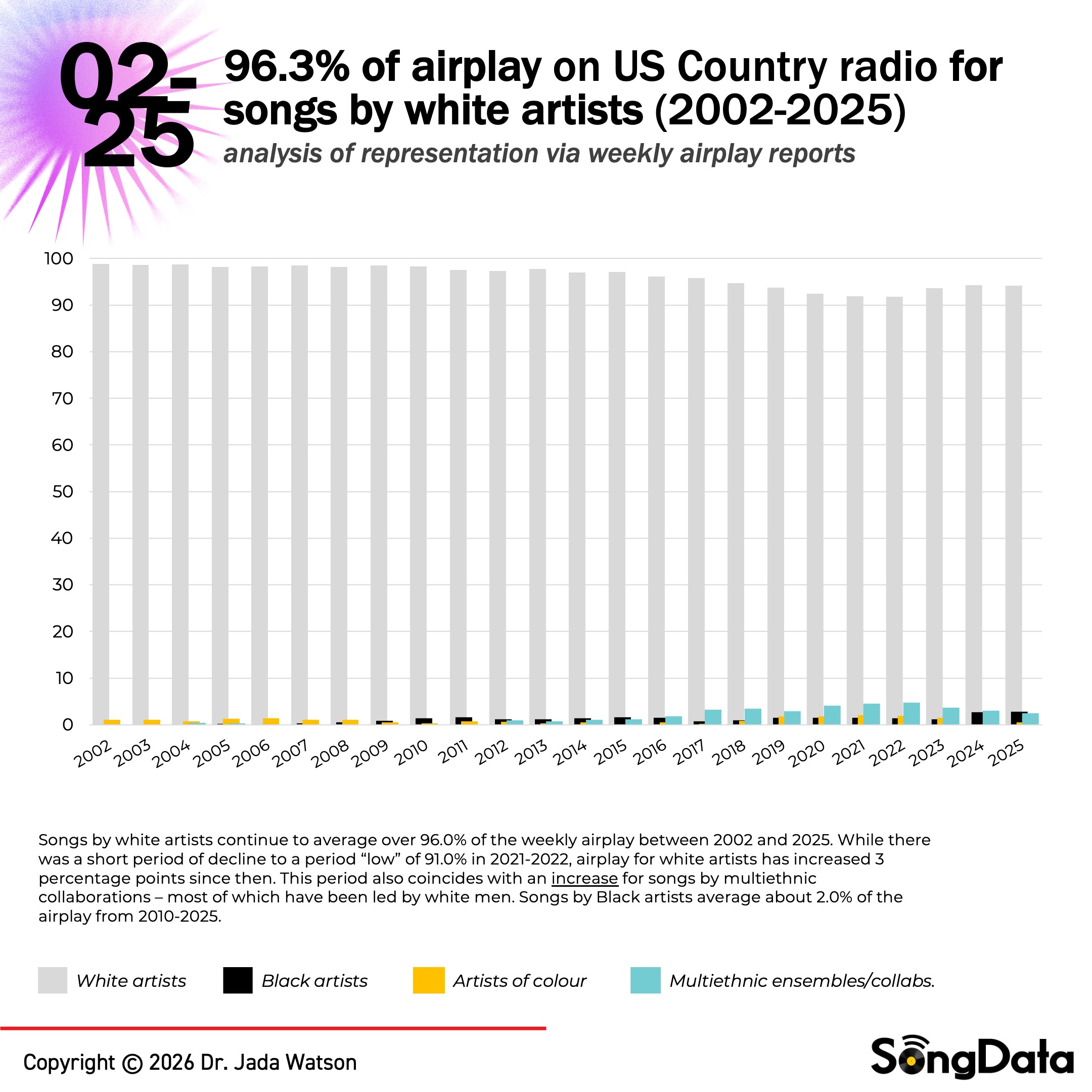
Songs by white artists continue to be prioritized in programming, a 25 year average of 96.3% of the airplay for their songs. The 2025 average lies just below that, at 93.12%. Songs by Black artists averaged 1.16% of the airplay over this period, 0.96% for artists of colour, and 1.58% for multiethnic collaborations and groups.
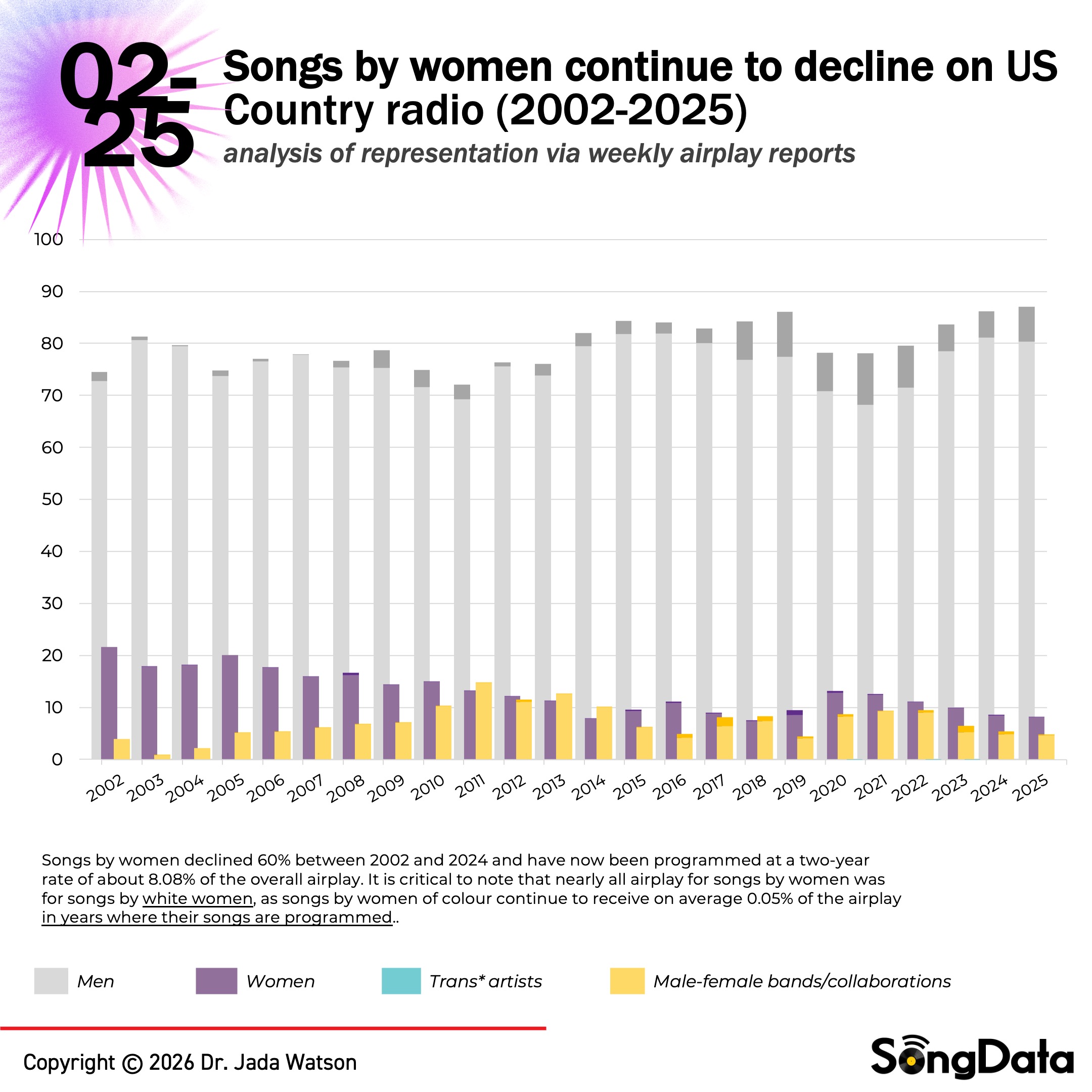
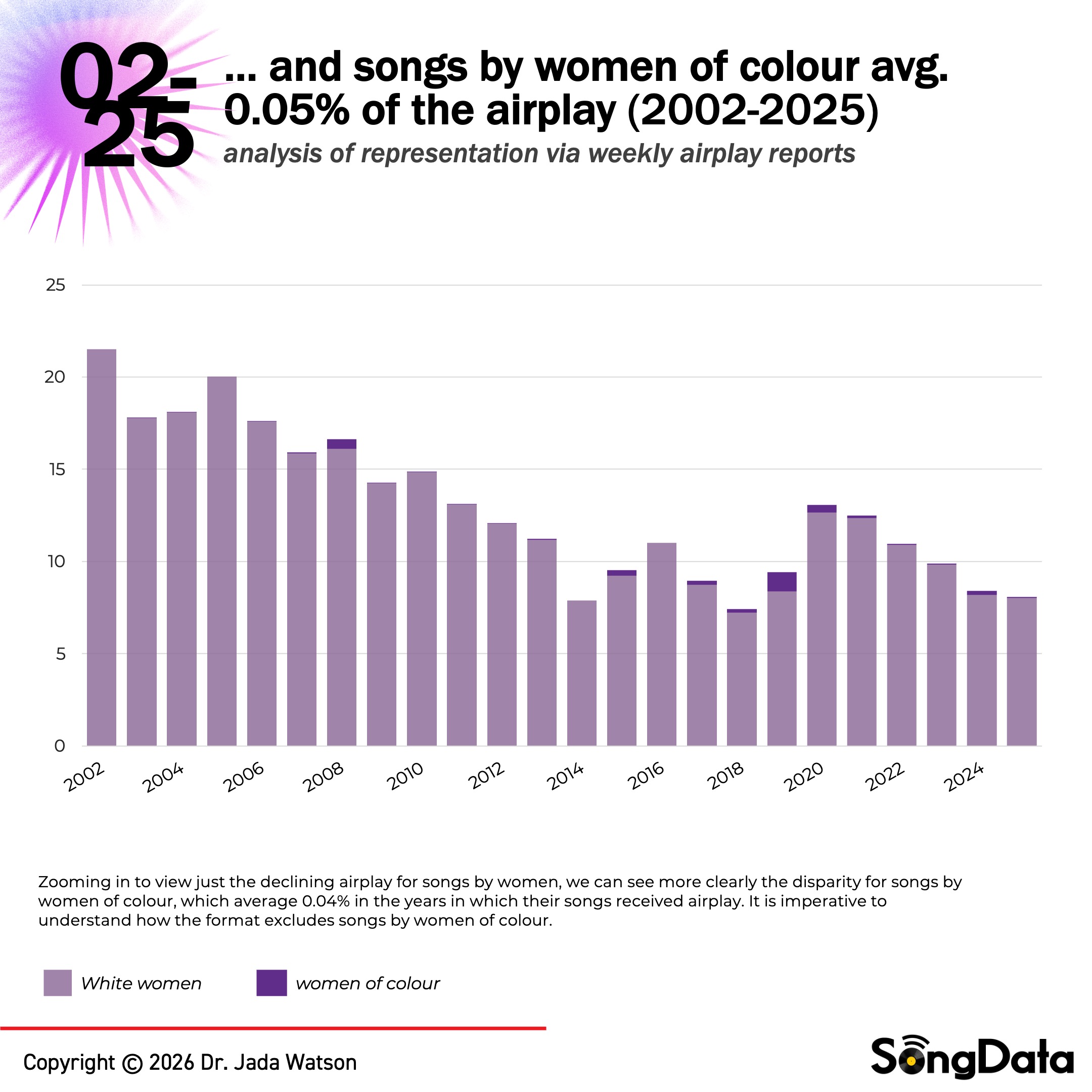
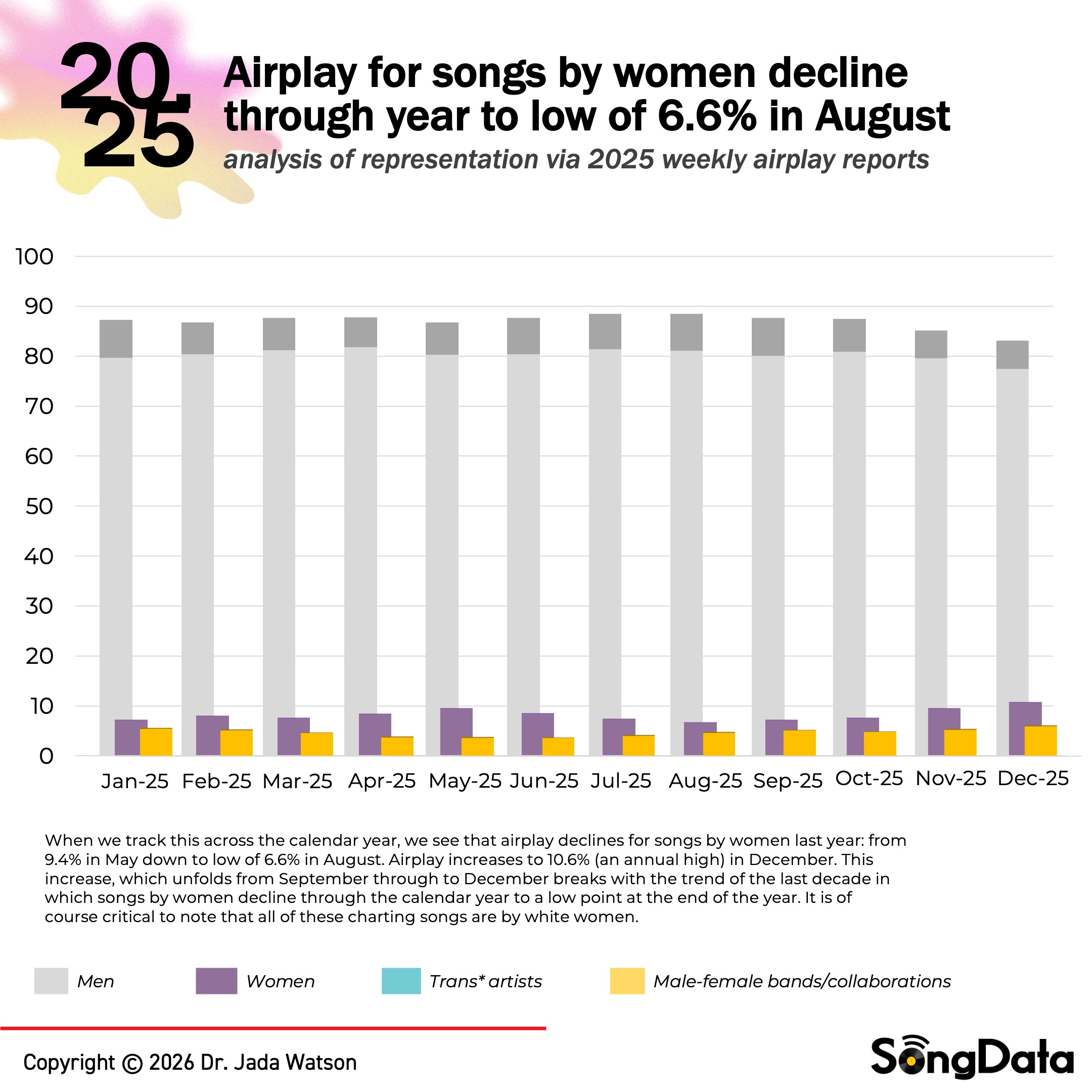
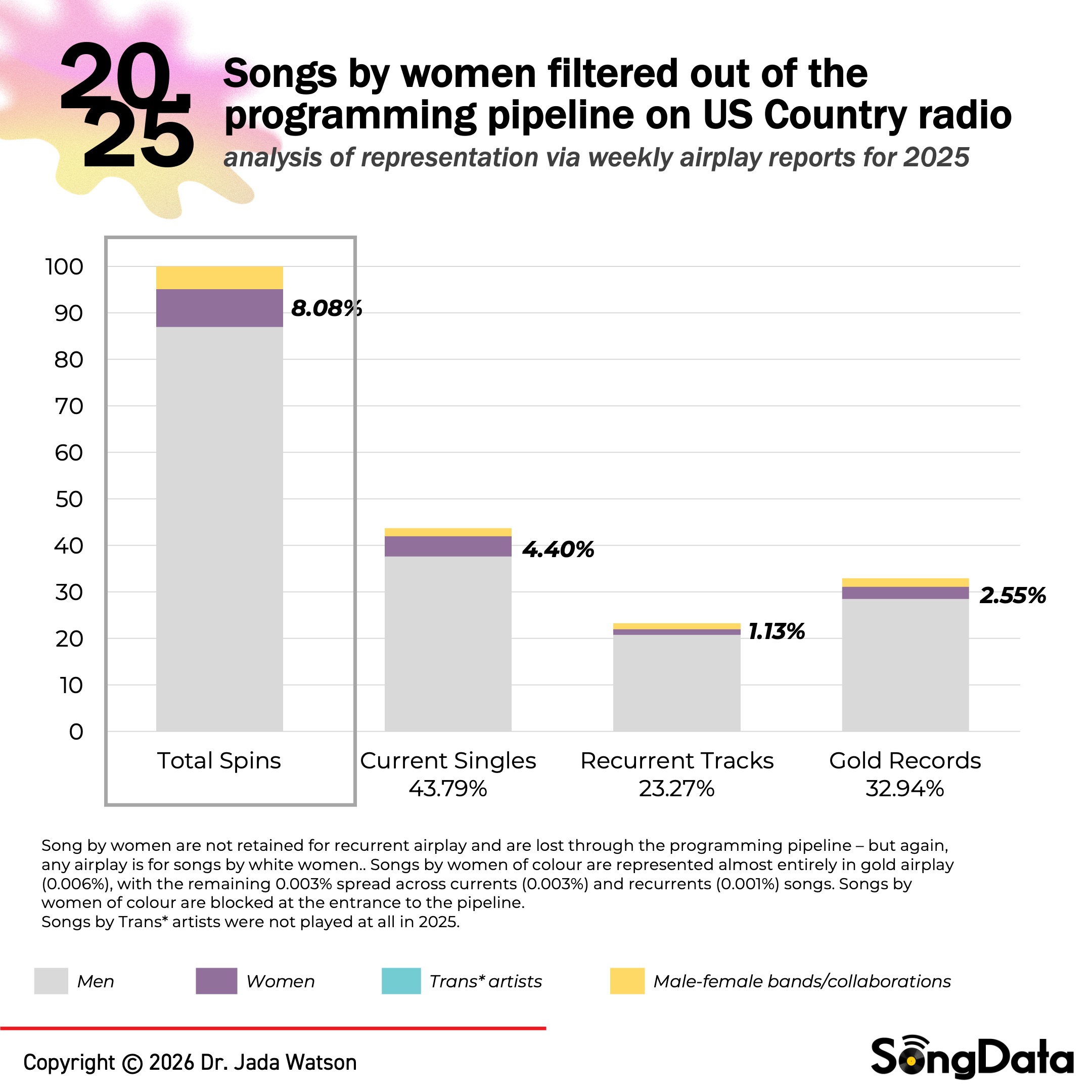
When we shift over to gender representation, we see a steady decline for songs by women between 2002 and 2025, down to a low of 8.08% of the airplay in 2025. And again, nearly entirely for songs by white women. Songs by women of colour average just 0.05% of total airplay in the years when songs by Black women are played but in 2025 that rate drops to 0.01%. Their music rarely enters the programming pipeline and is almost never sustained through recurrent airplay. In practical terms, songs by women of colour are largely blocked at the gate of the format.

Click an image to zoom in.
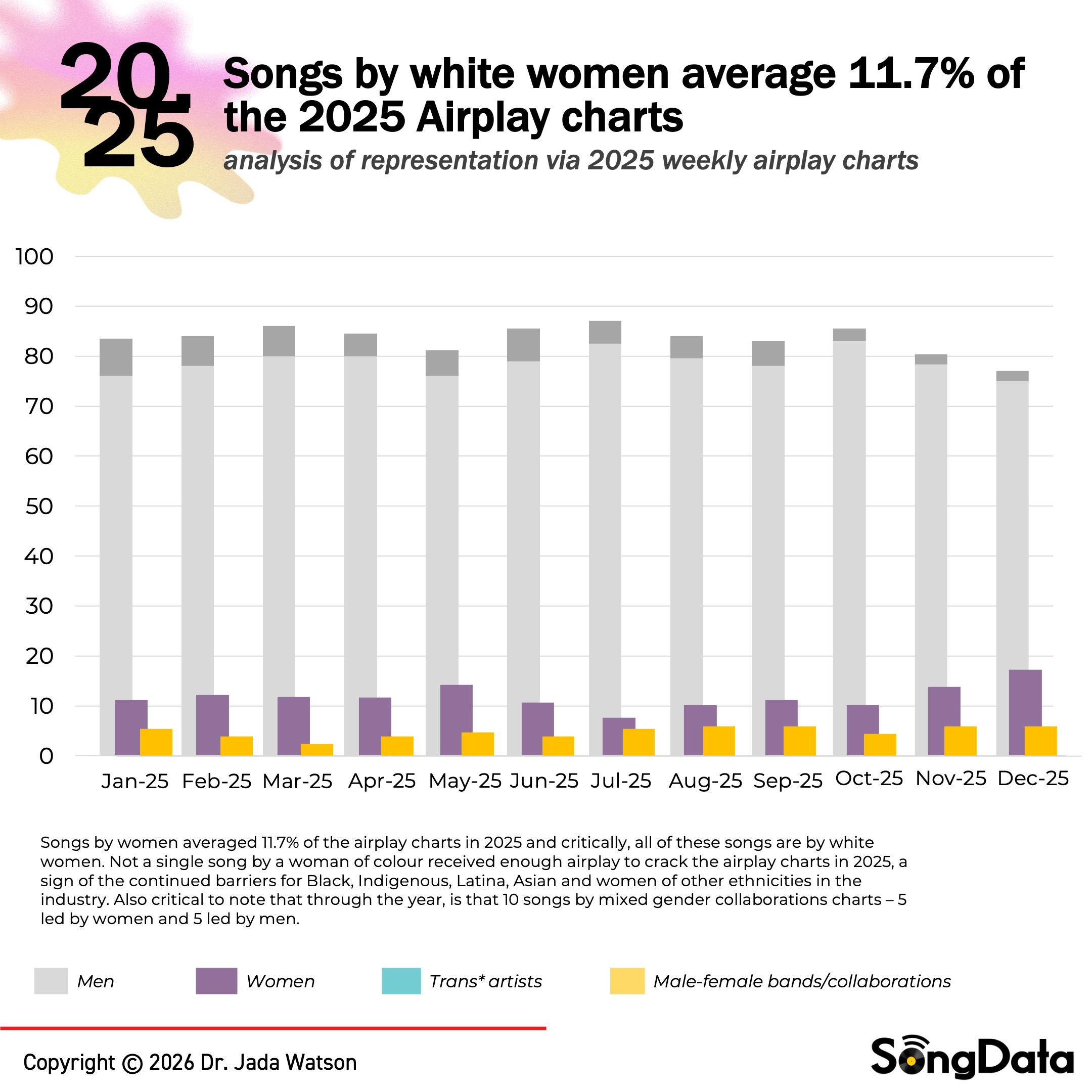
Let’s take a deeper dive into 2025. With 8.08% of the overall airplay, 8.03% was for songs by white women, while songs by Black women received just 0.01% of the airplay. The remaining 0.04% went to songs by multiethnic collaborations.
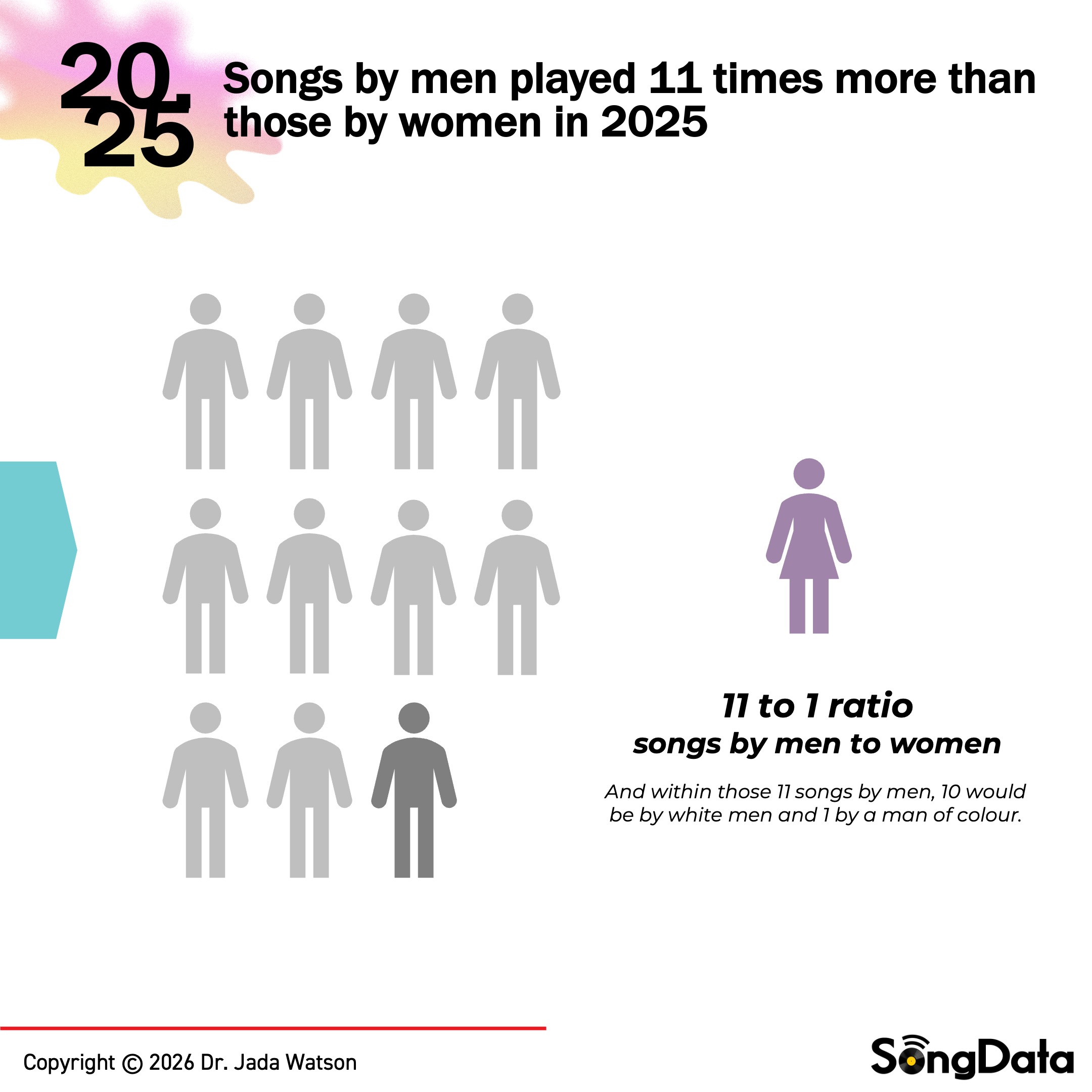
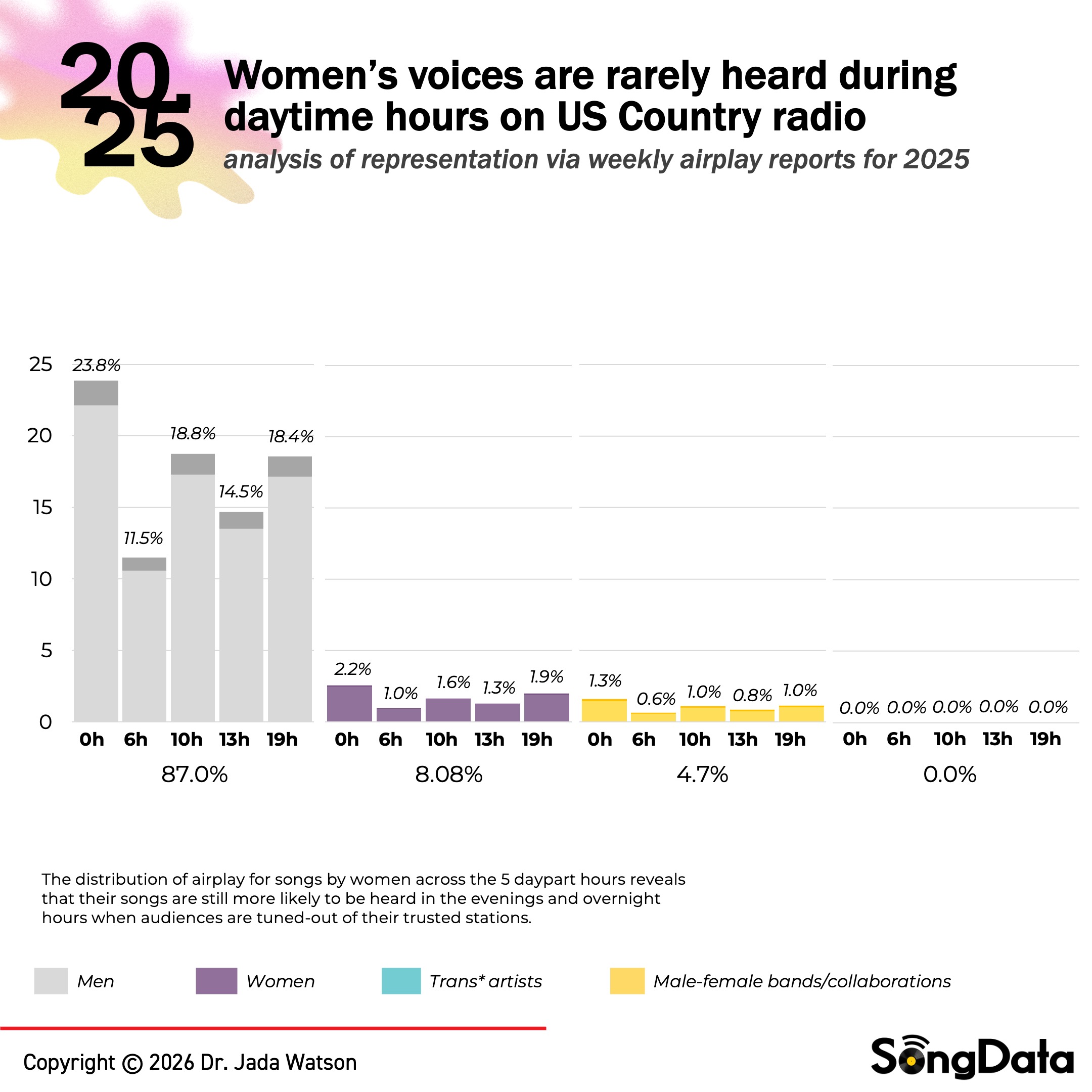
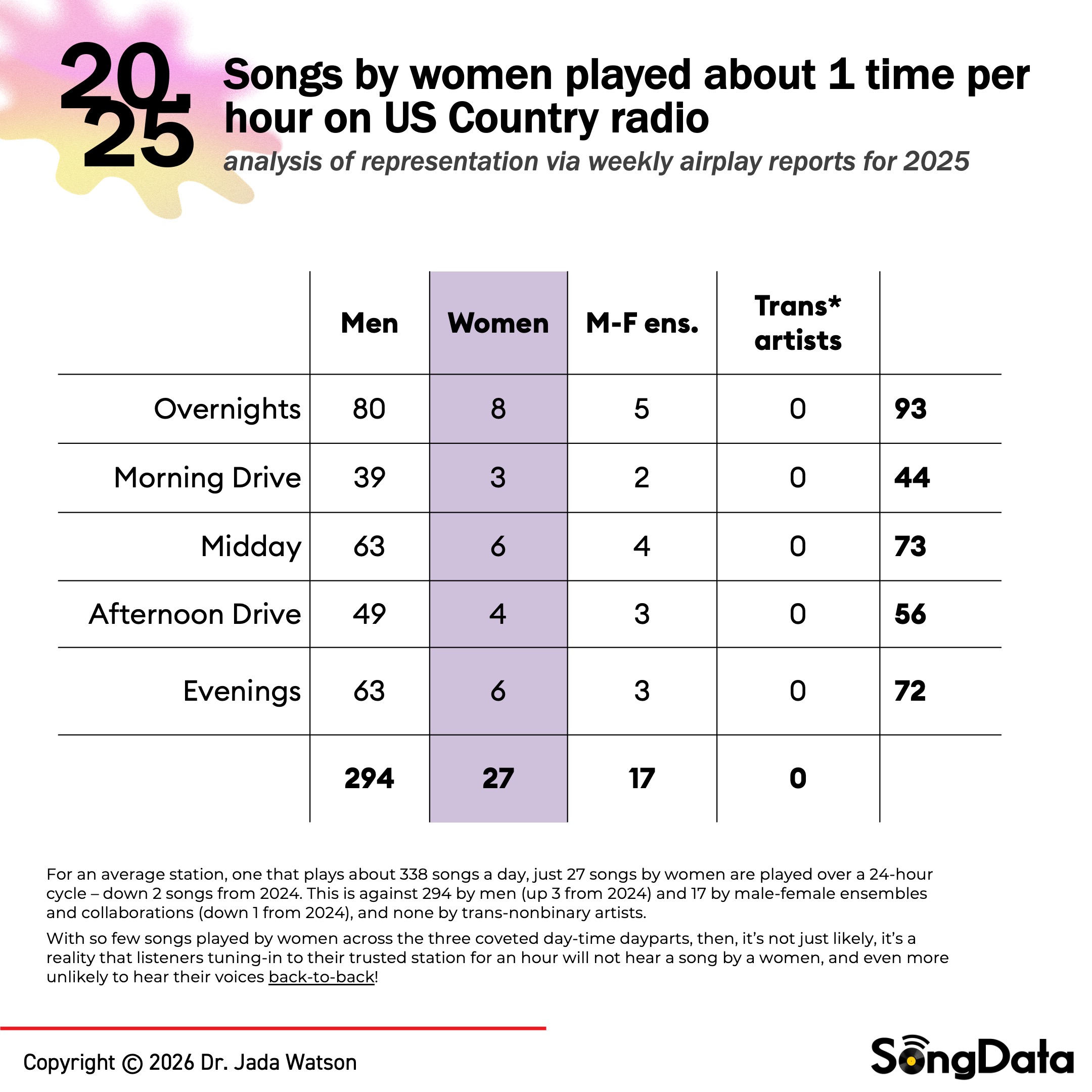
To put this into perspective, the average country radio station programs roughly 338 songs per day. Across a full 24-hour cycle, that translates to approximately 29 songs by women, compared to 294 songs by men. Because songs by women are still disproportionately scheduled during evening and overnight hours, listeners can easily tune in to their trusted station for an hour and not hear a single woman’s voice. When we look more closely at the distribution of airplay, the disparities become even more pronounced: about 11 songs by men are played per hour, while just 1 song by a woman is played.
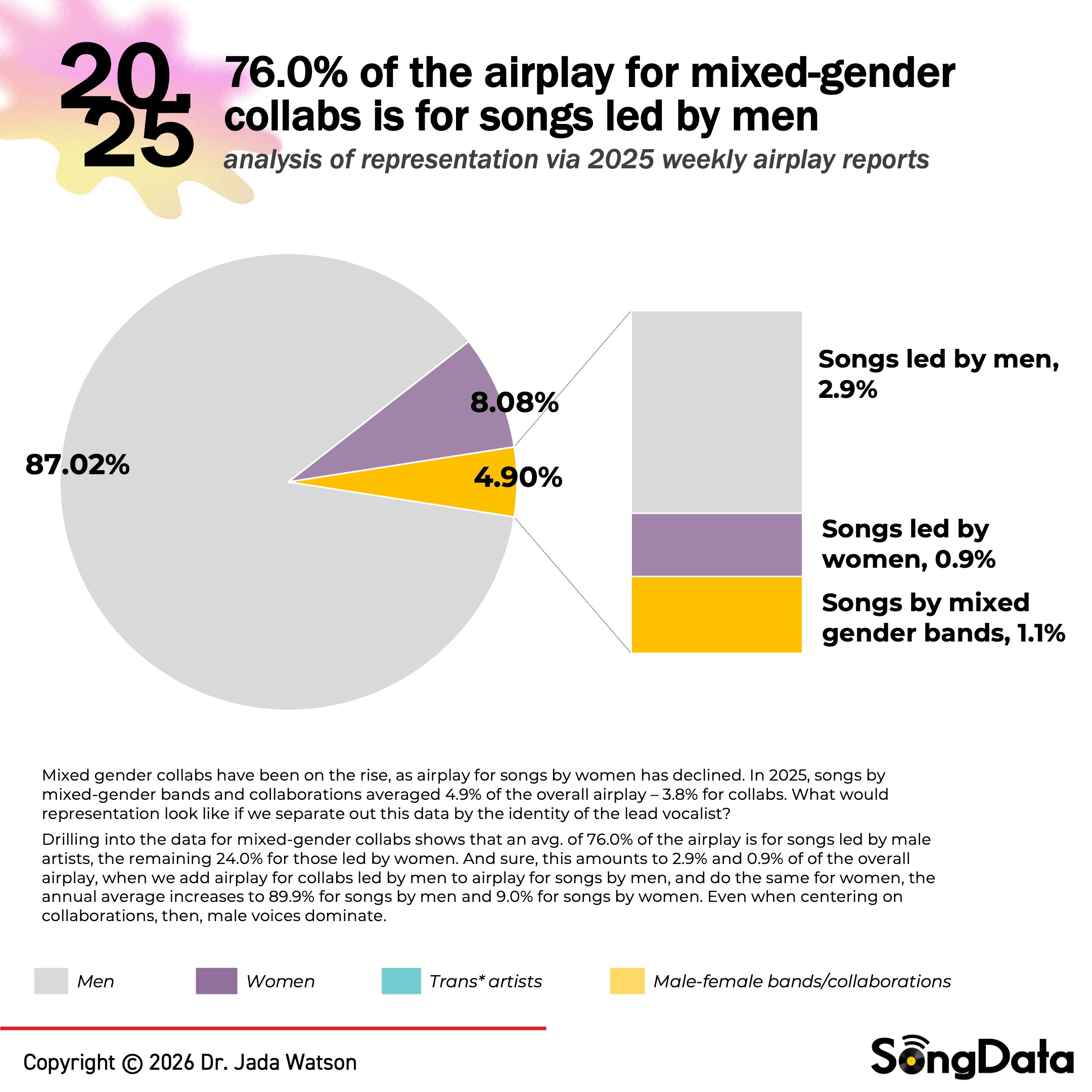
Mixed gender collabs have held a prominent place within the industry’s history, but they have been on the rise over the last decade. And as airplay has increased for collaborative records, airplay for songs by women has declined. In 2025, songs by mixed-gender bands and collaborations averaged 4.9% of the overall airplay – 3.8% overall for songs by collabs. What would representation look like if we separate out this data by the identity of the lead vocalist?
Drilling into the data for mixed-gender collabs shows that an avg. of 76.0% of the airplay is for songs led by male artists, the remaining 24.0% for those led by women. While they may only amount to to 2.9% and 0.9% of the overall airplay, it reveals another space through which songs by men are prioritized within programming. When we add airplay for collabs led by men to airplay for songs by men, and do the same for women, the annual average increases to 89.9% for songs by men and 9.0% for songs by women. Even when centering on collaborations, then, male voices dominate.

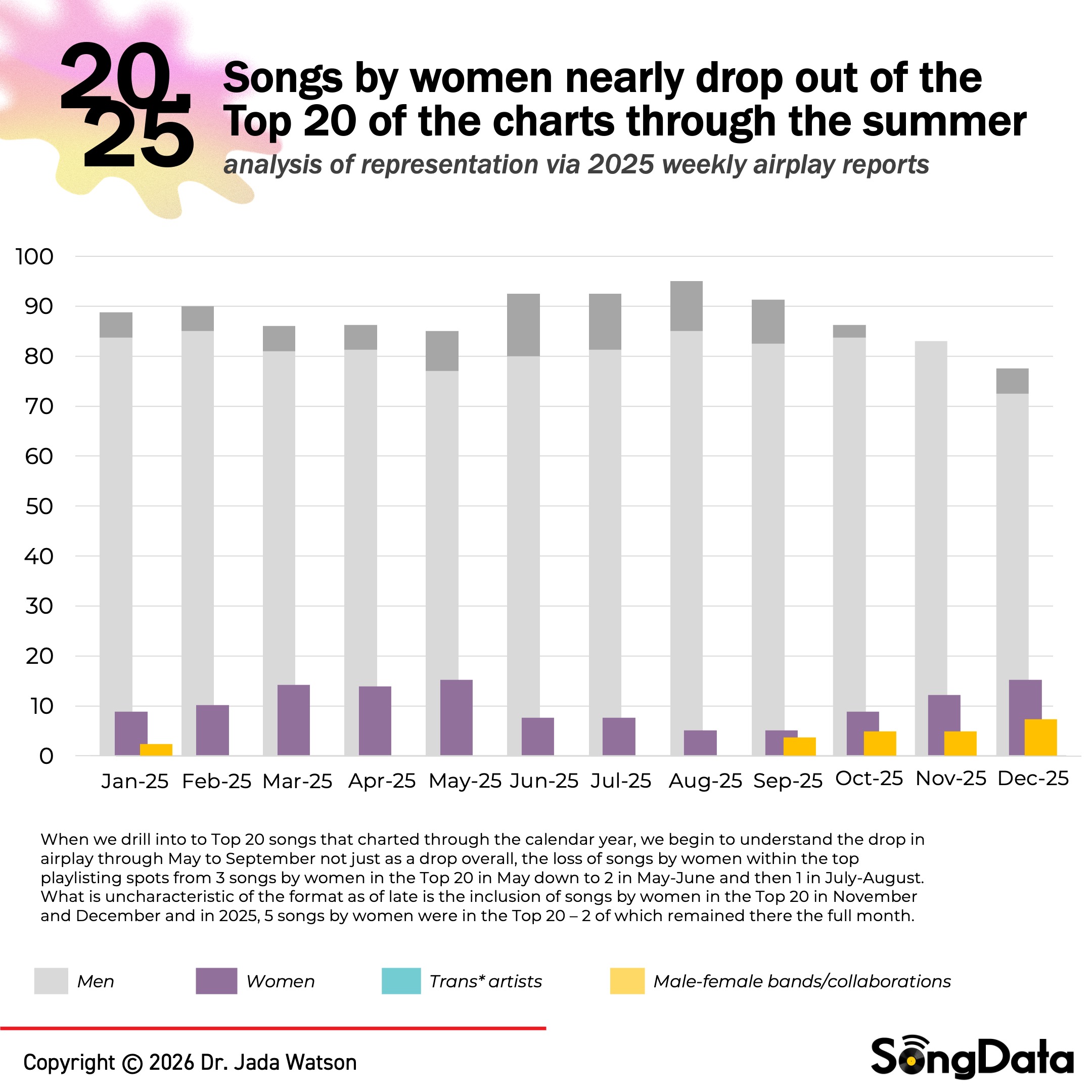
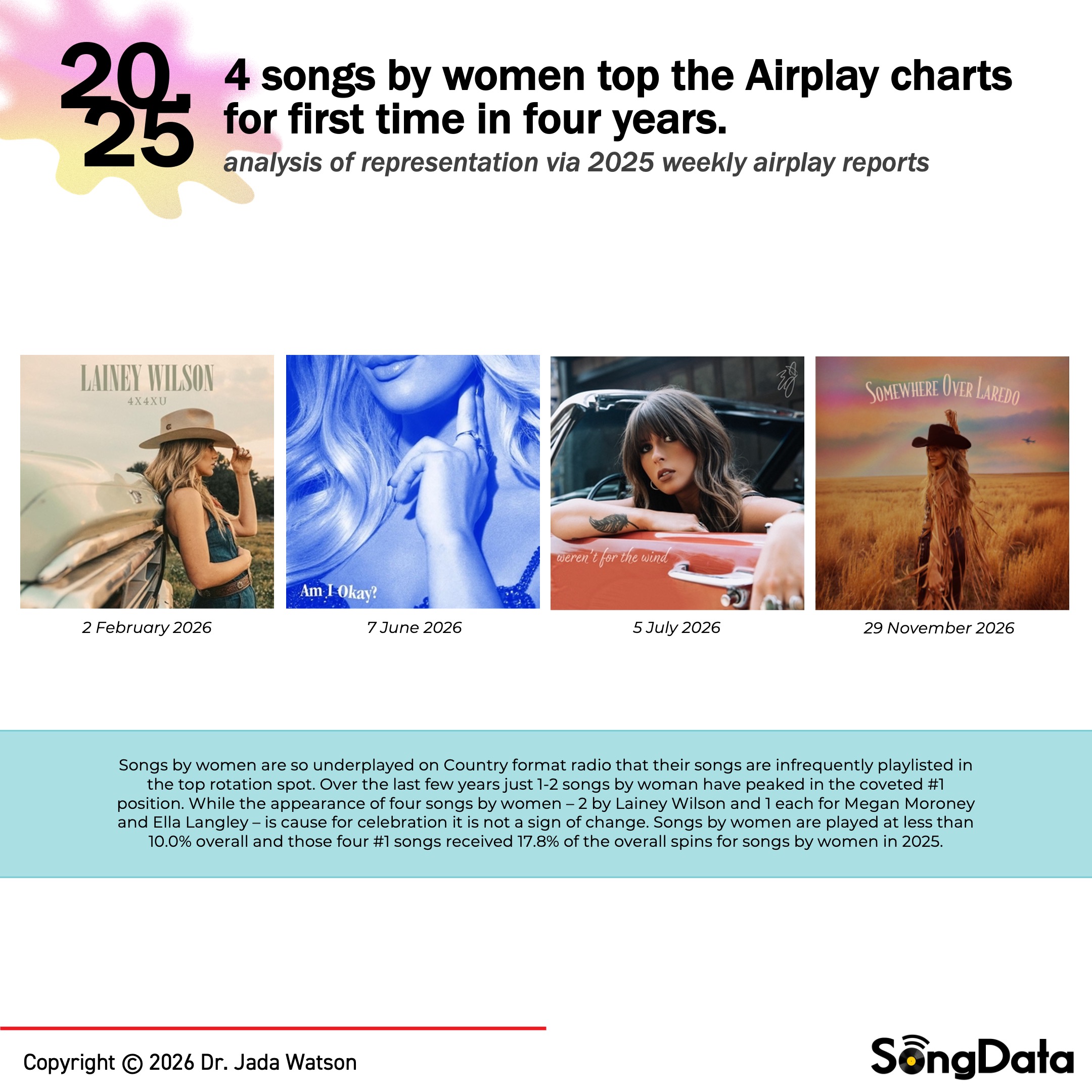
There were certainly notable moments in 2025. Four songs by white women reached #1 on country radio—two for Lainey Wilson, and one each for Megan Moroney and Ella Langley. The last time 4 songs by women reached the top of the charts in one calendar year was 2021, when songs by Kelsea Ballerini, Gabby Barrett, Tenille Arts, and Lainey Wilson were spun right to the top of radio playlists.
And in March 2026, Moroney and Langley made history as the first pair of female country artists to simultaneously top the Billboard Hot 100 and Billboard 200 charts.
Wilson, Moroney and Langley emerge as the top women played overall and their songs combined received 44.6% of the airplay for songs by women. Nearly half of the airplay for songs by women, was dedicated to songs by three female artists. That songs by just three (white) women received nearly half of the airplay for songs by women suggests not change, but a deep ingrained tokenism and the continuation of a practice that uplifts just three women at a time. We’ve seen this story before.
Lainey Wilson was the most played woman on Country radio for the third year in a row, but her songs received 12.6% less airplay than 2024 and this time she ranked 15th overall. (She ranked 11th overall in 2023.) The top-spun male artist had 4.3 times more airplay than Wilson and the top 10 most spun men captured 28.2% of the overall airplay in 2025.
Where are the rest of the top-spun women? Their songs land across the top 97-ranked artists. Their spins combined total 1.3 million—less than the two top-spun male artists.
Nine of the top 10 mixed gender groups are collaborations responsible for individual songs—4 of these songs received more spins than songs by most of the women on this list for accumulated airplay.
It is critical to note here that although airplay for songs by Black artists increased (marginally) to 3.8% in 2025, only one Black artist appears within these three lists of top 10 artists. It’s absolutely critical to recognize that (1) this 3.8% almost entirely for songs by men, and (2) this airplay was almost entirely for songs by three men. 82.2% of the airplay for songs by Black artists was for records by three men: 43.5% for songs by Shaboozey, 30.0% for songs by Kane Brown, and 8.7% for songs by Darius Rucker. The remaining airplay for songs by Black artists is spread across songs by 110 other artists, most of whom are not country artists. And to be clear, these statistics do not include airplay for multiethnic collaborations (so it does not include Shaboozey and Jelly Roll’s collaboration).

Click an image to zoom in.
But it is important not to confuse any of these moments—for Wilson, Langley, and Moroney or for Shaboozey—with structural change. This isn’t diversity. This is tokenism. It’s in industry masking its racism and sexism through the platforming of a small handful of artists—even better when these artists collaborate with white men.
Women in country music are increasingly finding success outside of country radio—through streaming platforms, touring, and broader popular audiences through opportunities outside of music. And this success is because of their growing fanbase, not the industry and certainly not radio (see Will Groff’s recent article on the topic). These successes are happening in spite of radio’s programming patterns rather than because of meaningful shifts within the format.
Two years after first presenting this research at Country Radio Seminar, the data tells the same story:
- Women’s voices remain dramatically underplayed.
- Women of colour remain almost entirely excluded.
- Trans* and nonbinary artists still receive no airplay at all.
- Black men remain tokenized.
Sharing numbers like this year after year is not easy. But documenting the reality of representation within the industry remains essential if we want to push for meaningful change in investment, promotion, and programming.
Until then, the words of Fannie Lou Hamer still apply:
“Nobody’s free until everybody’s free.”